If you are searching for a psychologist or therapist in South Delhi — whether in Saket, Greater Kailash, Defence Colony, Lajpat Nagar, Hauz Khas, or Malviya Nagar — you are navigating a crowded and sometimes confusing landscape. There are counsellors, psychologists, psychiatrists, life coaches, and hypnotherapists; there are clinics, wellness centres, and online platforms. Knowing how to choose well — and what questions to ask — can make the difference between a therapeutic relationship that genuinely helps and one that does not.

This guide is written to help you make that choice clearly. It draws on 35 years of practice in South Delhi and on the questions that new clients most commonly ask when they reach out for the first time.

Why South Delhi Is a Hub for Psychological Care

South Delhi has quietly become one of the most concentrated areas for psychological and wellness services in India. The density of educated, working professionals, the presence of major hospitals and medical infrastructure, the proximity to embassies and international institutions, and the long-standing culture of health awareness in neighbourhoods like Vasant Vihar, Greater Kailash, and Saket have all contributed to this.

Saket in particular — home to the Select Citywalk area and several major hospitals including Max and Escorts — has developed a strong ecosystem of specialist health services, including psychological care. Clients in Saket, GK I, GK II, Defence Colony, Lajpat Nagar, and the surrounding areas increasingly seek out psychologists, hypnotherapists, and counsellors who combine clinical rigour with a personalised, relationship-based approach.

What the best practitioners in South Delhi share is this: a genuine commitment to the individual in front of them, rather than a one-size-fits-all protocol. Delhi's diversity of culture, background, and presenting concern demands an adaptable, nuanced approach — and that is what separates truly effective psychological care from the generic.

"The neighbourhoods of South Delhi are full of people who are managing enormous pressure in silence. They are looking for someone who will actually listen — not diagnose and prescribe in forty minutes."
— Anuradha Banerji Sarkar

What to Look For in a South Delhi Psychologist

Not all credentials are equal, and not all practitioners who call themselves psychologists or therapists are equally qualified. Here is what to look for:

Qualifications: A legitimate psychologist should hold at minimum a postgraduate degree (MA or MSc) in Psychology or Applied Psychology from a recognised university. Additional certifications in specific modalities — CBT, hypnotherapy, trauma therapy — are valuable. Be wary of practitioners whose primary credential is a short online course.

Experience: Years of practice genuinely matter in psychological work. The skills of listening, of reading what is unsaid, of knowing when to push and when to hold back — these develop only with time and hundreds of hours of clinical practice. A practitioner with 3–5 years of experience is still developing. One with 20–35 years brings a depth that is qualitatively different.

Approach: The best psychologists in South Delhi are integrative — they do not apply a single protocol to every client regardless of what the client actually needs. Look for someone who will assess your specific situation and draw from multiple modalities: CBT, counselling, hypnotherapy, or other approaches as appropriate.

Language: For many Delhi clients, especially those from Bengali, Hindi, or regional Indian backgrounds, the ability to work in one's first language is not a convenience but a clinical necessity. Emotional truth often surfaces most authentically in the language we first learned to express it in.

Cultural sensitivity: South Delhi's psychological challenges are shaped by very specific cultural forces: competitive academic environments, joint family pressures, marriage and career expectations, caste and class dynamics, and the specific stressors of urban Indian professional life. A good Delhi psychologist understands these not as background noise but as central to the clinical picture.

Types of Therapy Available in South Delhi

South Delhi offers access to a broad range of therapeutic modalities. The most commonly available — and most effective — include:

Counselling Psychology is the most accessible entry point. It provides a safe, non-judgmental space to talk through difficulties, process emotions, and develop greater self-understanding. Suitable for most presenting concerns, especially for clients who are new to therapy.

Cognitive Behavioural Therapy (CBT) is the world's most researched psychological treatment. Structured and skill-based, it works by identifying and changing unhelpful thought patterns and behaviours. Particularly effective for anxiety, depression, OCD, and performance anxiety — all common among South Delhi's professional population.

Clinical Hypnotherapy works at the subconscious level — accessing and changing patterns that conscious thought alone cannot reach. Highly effective for habit change (smoking, weight), phobias, anxiety, insomnia, and confidence. Increasingly sought after in South Delhi as awareness grows.

Past Life Regression is a specialised form of hypnotherapy that explores psychological material beyond the current lifetime. For clients with unexplained phobias, recurring patterns, or deep spiritual questions, it can produce remarkable results.

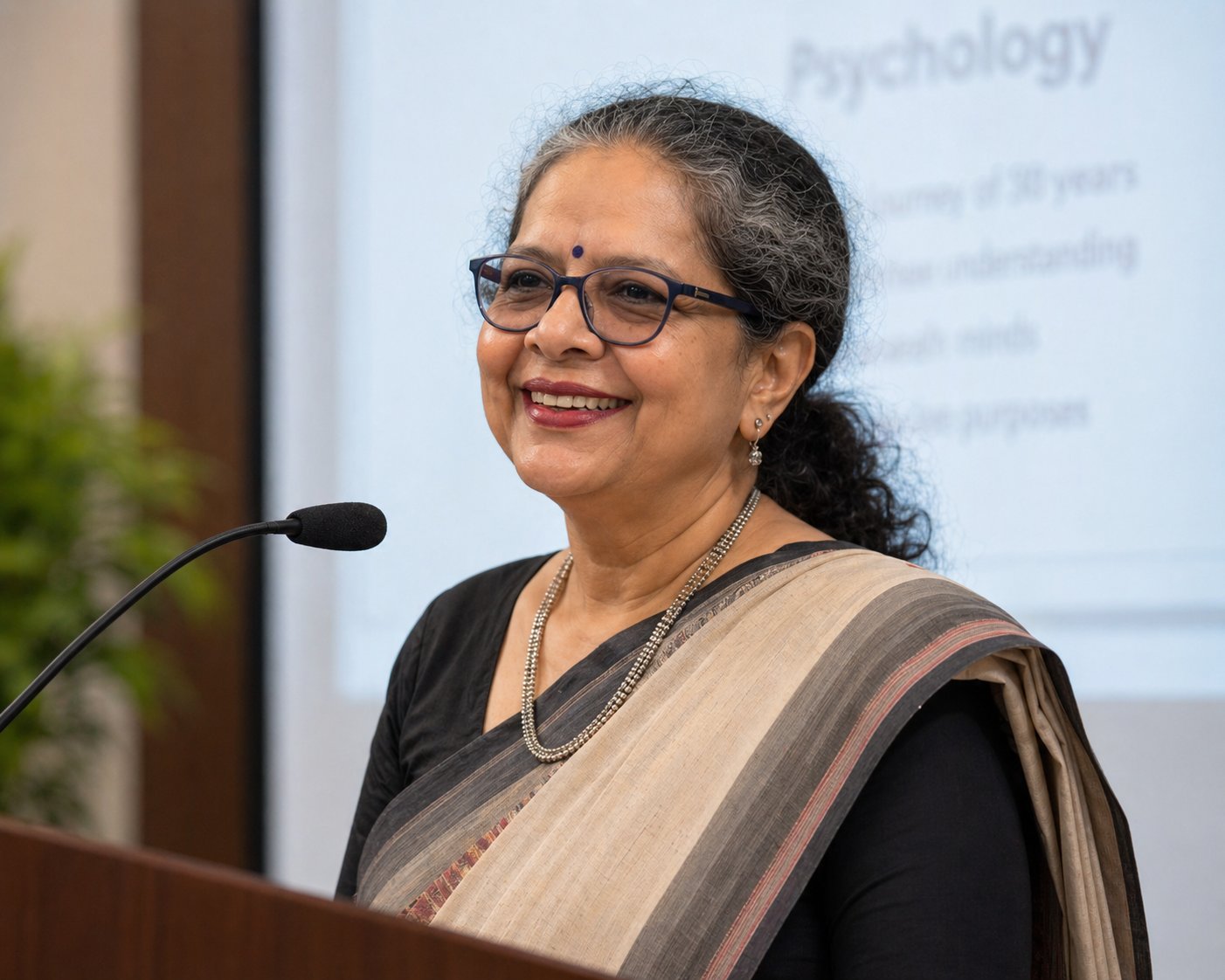
Anuradha Banerji Sarkar — Psychologist in South Delhi
Anuradha Banerji Sarkar — practising in South Delhi for over 35 years

In-Person vs Online Therapy in Delhi — Which Is Better?

This is one of the most common questions from new clients in Delhi, particularly those based in Gurgaon, Noida, or the more distant parts of NCR for whom travelling to South Delhi requires navigating significant traffic.

The honest answer is that the research does not clearly favour either format for most presenting concerns. Online CBT, counselling, and even hypnotherapy have all been shown to produce outcomes comparable to in-person work when conducted well. The therapeutic relationship — the quality of the connection between client and therapist — matters far more than the medium through which it happens.

The practical case for online therapy in Delhi's context is strong: it eliminates commute time (which can be 45–90 minutes each way from Gurgaon or Noida), allows clients to be in the comfort and privacy of their own space, makes it easier to maintain regularity during Delhi's extreme weather (summer heat, monsoon disruption, winter fog), and opens access to practitioners across the city and country regardless of geography.

The case for in-person work is equally real for some clients: there is a depth and embodied quality to sitting with another human being in the same room that some people find irreplaceable, particularly for trauma work or for those who find it harder to open up on a screen.

Anuradha Banerji Sarkar offers both — and is happy to discuss which is likely to serve you best in an initial conversation.

What to Expect in Your First Session with a South Delhi Psychologist

Many people who are considering therapy for the first time feel uncertain about what to expect in that first session — and sometimes this uncertainty is enough to delay reaching out. Here is a realistic picture.

The first session is not therapy. It is an assessment and a conversation. A good psychologist will spend most of the first session listening — understanding who you are, what brings you in, what your history looks like, and what you are hoping to get from the work. They will not rush to diagnosis or treatment planning. They will not offer advice unless you specifically ask for it. They will not make you feel judged or analysed.

By the end of the first session, you should have a sense of whether this is a person you can work with — whether you feel heard, whether you trust them, whether their approach seems appropriate for your situation. If you do not, that is important information. Not every therapist is right for every client, and the fit matters enormously.

Anuradha's first sessions are exactly this: unhurried, warm, genuinely exploratory — with no pressure to commit to anything before you are ready.

Areas in South Delhi and NCR Served

Anuradha's South Delhi practice serves clients from across the city and NCR — in-person and online:

Areas served in South Delhi and NCR:

Saket
Greater Kailash I
Greater Kailash II
Defence Colony
Lajpat Nagar
Malviya Nagar
Hauz Khas
Vasant Vihar
Vasant Kunj
Green Park
South Extension
Safdarjung Enclave
Andrews Ganj
Nehru Place
Gurgaon / DLF
Noida / Sector 18
Faridabad
Ghaziabad
📅 Book a Session with Anuradha
Reach out today — response within 24 hours.
South Delhi (in-person) · Online for NCR, India & International · ₹2,000 per session · Hindi, English & Bengali
WhatsApp to Book ✉️ Send Email
Frequently Asked Questions
A psychologist holds a postgraduate degree in psychology and provides talking therapy, counselling, CBT, hypnotherapy, and other psychological interventions. A psychiatrist holds a medical degree and is qualified to prescribe medication. In Delhi, many people benefit from seeing both — a psychiatrist for medication management and a psychologist for the therapeutic work. Anuradha Banerji Sarkar is a psychologist; she does not prescribe medication but can work alongside your psychiatrist.
Look for: a genuine postgraduate qualification in psychology; relevant clinical experience (10+ years ideally); an integrative approach rather than a rigid single method; the ability to work in your preferred language; and cultural familiarity with Delhi's specific pressures. Anuradha Banerji Sarkar practises in South Delhi with 35+ years of experience and offers sessions in English, Hindi, and Bengali.
Yes — psychological therapy in India is bound by professional confidentiality. What you share in sessions is not disclosed to anyone else without your explicit consent, except in very specific circumstances required by law (such as imminent risk to life). Your privacy is always protected.
Yes. All sessions — whether in-person at the South Delhi practice or online — are entirely confidential. You do not need to tell anyone you are attending therapy. The clinic's discretion is absolute.
Fees for psychological services in South Delhi vary widely, typically between ₹1,500 and ₹5,000 per session depending on the practitioner's experience and specialisation. Anuradha Banerji Sarkar charges ₹2,000 per 60-minute session — in-person and online.