Delhi's professional class is under pressure. The capital's corporate landscape — spanning finance, consulting, technology, media, law, and government — combines global standards of performance with Indian standards of personal and family obligation in ways that create an almost uniquely demanding set of psychological challenges.

The result is a silent epidemic of burnout, anxiety, imposter syndrome, relationship breakdown, and substance use that costs organisations as much as it costs individuals — but that is almost never discussed openly in meeting rooms or performance reviews.

This article is for the professionals who are managing more than they are letting on.

Delhi's Work Culture and Its Mental Health Cost

Delhi is not Mumbai — but it is developing similar patterns of professional overextension. The city's economy has diversified rapidly over the past two decades: corporate headquarters, startup ecosystems, government and policy work, international NGOs and bilateral institutions, media and entertainment, and one of Asia's largest legal industries have all concentrated here, bringing with them long hours, hierarchical pressures, and the specific psychological weight of being visible and evaluated.

Add to this the particular dynamics of Delhi's social culture — where professional success is not a private achievement but a family and community matter, where one's job title and salary are semi-public knowledge at family gatherings, where the comparison with peers is constant and often vocalised — and you have an environment in which professional identity becomes deeply entangled with self-worth in ways that make any professional difficulty feel existentially threatening.

The professionals who come to Anuradha's South Delhi practice are — on paper — successful. They hold good titles, earn good salaries, maintain functional families. Inside, many are exhausted, isolated, performing, and afraid that the gap between how they appear and how they feel is growing by the year.

"The professionals who come to me are not failing. They are succeeding at enormous cost. The therapy is about learning that their worth is not conditional on their performance."
— Anuradha Banerji Sarkar

Recognising Burnout — Delhi's Most Under-Diagnosed Condition

Burnout is not the same as tiredness. It is a state of chronic psychological and physiological depletion produced by sustained, unresolved work stress. The World Health Organisation now classifies it as an occupational phenomenon. Its three core dimensions are: exhaustion (physical and emotional), cynicism or detachment from work (once something you cared about has become something you endure), and a reduced sense of professional efficacy (the creeping feeling that you are no longer competent or effective, even when the external evidence says otherwise).

In Delhi's high-performance professional environments, burnout is routinely misidentified — as laziness, as depression, as a personality problem, as evidence of the person not being "tough enough." None of this is accurate. Burnout is a systemic and psychological condition that requires specific intervention, not willpower.

Hypnotherapy and CBT — the two modalities Anuradha uses most frequently with professional clients — address burnout at different but complementary levels. CBT helps identify and change the cognitive patterns (perfectionism, catastrophising, the inability to delegate or rest) that maintain the burnout cycle. Hypnotherapy works deeper — addressing the subconscious beliefs about worth, achievement, and safety that make the cycle so difficult to exit.

Why Hypnotherapy Works Particularly Well for Professionals

Professional clients — especially those in analytical, high-cognitive-demand roles — sometimes approach hypnotherapy with scepticism. This is understandable and, in Anuradha's experience, often reflects exactly the dynamic that needs addressing: a hyper-rational, high-control orientation to the world that has been enormously useful professionally but that makes it very difficult to access and work with the emotional and subconscious material driving distress.

The hypnotic state, precisely because it temporarily quietens the critical, analytical mind, offers these clients access to parts of themselves they have learned to override in their professional environments. In this state, deeply held beliefs about being fundamentally inadequate, about deserving punishment for imperfection, about self-care being weakness — beliefs that no amount of rational discussion can fully dislodge — become accessible and workable.

Many of Anuradha's most dramatic therapeutic outcomes have been with exactly these clients: senior professionals for whom conventional talk therapy had reached its limits, but who found in hypnotherapy a pathway to changes they had not thought possible.

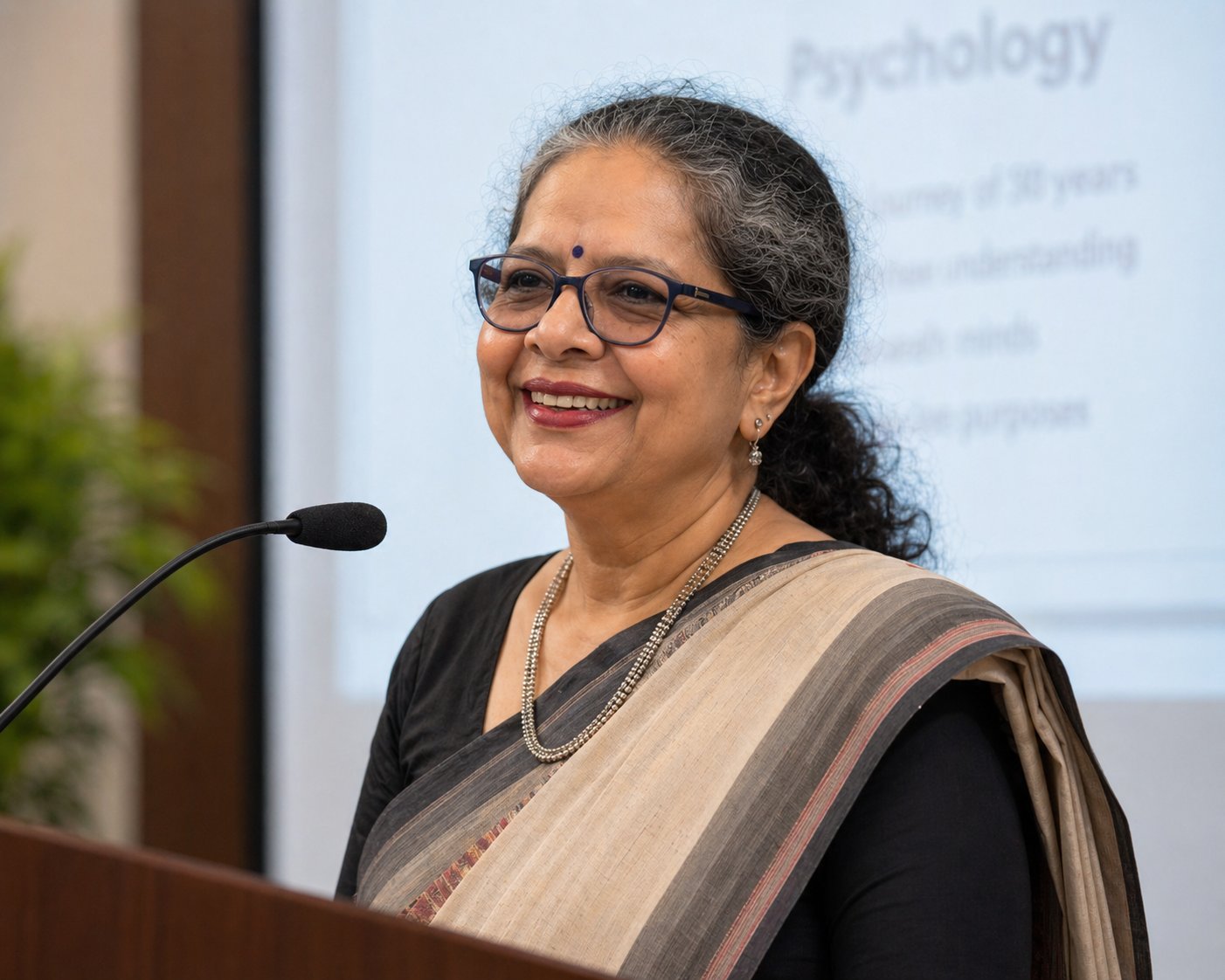
Anuradha Banerji Sarkar speaking at a psychology event in Delhi
Anuradha speaking at a psychology event in Delhi — bringing clinical expertise to professional audiences

CBT for Workplace-Specific Challenges in Delhi

CBT is particularly well-suited to the specific cognitive challenges of Delhi's professional environments. The most common patterns Anuradha sees in professional clients include:

Perfectionism — an inability to tolerate anything short of excellence that produces chronic anxiety, procrastination, overwork, and difficulty delegating. CBT identifies the specific beliefs underlying the perfectionism (often something like "if I make a mistake, I will be exposed as incompetent") and replaces them with more balanced, functional standards.

Imposter syndrome — the pervasive feeling that one's success is undeserved and that one is about to be "found out." Extraordinarily common among high-achieving Delhi professionals, particularly women and those from non-elite educational backgrounds. CBT systematically challenges the cognitive distortions maintaining the imposter narrative.

Social anxiety in professional settings — fear of speaking in meetings, presenting to senior leadership, networking, or being assessed. Often connected to deep beliefs about judgement, rejection, or inadequacy. Responds very well to a combination of CBT (conscious skill-building) and hypnotherapy (deeper subconscious work).

Online Therapy for Delhi's Busy Professionals

One of the most significant practical barriers to therapy for Delhi professionals — particularly those based in Gurgaon, Noida, or the parts of Delhi that require significant commuting — is time. A round-trip to a South Delhi clinic, factoring in traffic, can consume two to three hours. For a professional managing a 10–12 hour work day and family obligations, this is often prohibitive.

Online therapy — via secure video call — eliminates this barrier entirely. Sessions can be taken during a lunch break, from a home office, from a hotel room on a business trip. The therapeutic quality is comparable. Anuradha has been conducting online sessions for several years and has seen no meaningful difference in outcomes compared to in-person work for the vast majority of presenting concerns.

When to Seek Help — and Why Now

The most common reason professional clients give for not seeking help sooner is that they were waiting until things got bad enough to justify it. This is the wrong framework. Psychological care works far better when sought early — when the patterns are less entrenched, the depletion less advanced, and the recovery quicker.

If you recognise yourself in any of what this article describes — the performance, the exhaustion, the gap between the professional self you present and the person you actually are — that recognition is sufficient reason to reach out. You do not need to be in crisis.

Areas served in South Delhi and NCR:

Saket
Greater Kailash
Defence Colony
Hauz Khas
Vasant Vihar
Gurgaon
Noida Sector 18
Noida Sector 62
Cyber City Gurgaon
Connaught Place
Nehru Place
Faridabad
📅 Book a Session with Anuradha
Reach out today — response within 24 hours.
South Delhi (in-person) · Online for NCR, India & International · ₹2,000 per session · Hindi, English & Bengali
WhatsApp to Book ✉️ Send Email
Frequently Asked Questions
Yes — and it is one of the most important applications of psychological care in Delhi's professional landscape. Anuradha uses a combination of CBT (to address the perfectionist and overachiever patterns maintaining the burnout) and hypnotherapy (to reach the deeper beliefs about worth and safety that make it so hard to rest) to produce lasting, meaningful recovery.
Absolutely. All sessions — whether in-person at the South Delhi practice or online — are bound by strict professional confidentiality. Your employer, colleagues, and family are never informed. The only exceptions are very specific legal obligations (such as imminent risk to life), which Anuradha will explain clearly in the first session.
Yes. Anuradha offers online sessions via secure video call for clients across Delhi NCR — including Gurgaon, Noida, Faridabad, and Ghaziabad — as well as pan-India and internationally. Sessions are fully effective online and eliminate the commute challenge.
Yes. Career anxiety — fear of redundancy, imposter syndrome, performance reviews, job transitions, and leadership challenges — is one of the most common presentations in Anuradha's practice. Her approach is specific and practical, not generic: she understands Delhi's professional culture and the particular psychological pressures it creates.
Yes — this is one of hypnotherapy's most reliably effective applications. Fear of speaking in meetings, presenting to senior leadership, or being assessed in public settings responds very well to hypnotherapy combined with CBT. Many of Anuradha's professional clients have reported significant confidence improvements within 3–5 sessions.