People sometimes ask Anuradha Banerji Sarkar how she came to her life's work, expecting a tidy narrative. The actual account is more useful: a series of genuine questions, honestly pursued, that led her from the expected path to the one that turned out to be genuinely hers.
The Person People Came To
She grew up in Kolkata, in a family of high achievers, and from early childhood was the person her peers sought out when something was difficult. Not for advice — she gave relatively little of it — but for the quality of attention she brought. She was, people felt, actually present with what they were sharing. This capacity — for genuine, non-distracted, non-judgmental reception of another person's experience — was not a skill she developed. It was simply how she engaged with people. Understanding it as the foundational competence of psychological work came later, through her clinical training.
Medicine or the Mind?
The conventional direction for a capable, academically strong woman from her background was medicine. She had the aptitude. She had the desire to help. And medicine seemed the most direct expression of that desire — respected, structured, consequential. For a time, she assumed she would pursue it. What gave her pause was what she observed in clinical environments: how often the people seeking medical care were not straightforwardly physically ill. They were suffering in ways that the diagnostic and pharmaceutical apparatus could address partially but not fully. The recurring patient. The unexplained symptom. The physical deterioration that corresponded with visible life stress. These cases raised questions that medicine's framework did not have immediate room for, and those questions kept pulling her attention.
The Clarifying Insight
At Kolkata University, her study of psychology — and particularly the then-emerging field of psychosomatic medicine — gave her the conceptual framework for what she had intuitively understood. The mind and body are not separate systems. Psychological states — sustained anxiety, chronic grief, shame, the specific burden of unresolved early experience — produce measurable physical changes. Beliefs formed in childhood alter adult physiology in ways that no amount of adult reasoning reverses. To treat the body without the mind is to treat the symptom while leaving the source untouched. This was not a theoretical position she adopted from a book. It was a recognition she arrived at and has not had reason to revise in 35 years of clinical practice.
35 Years in South Delhi
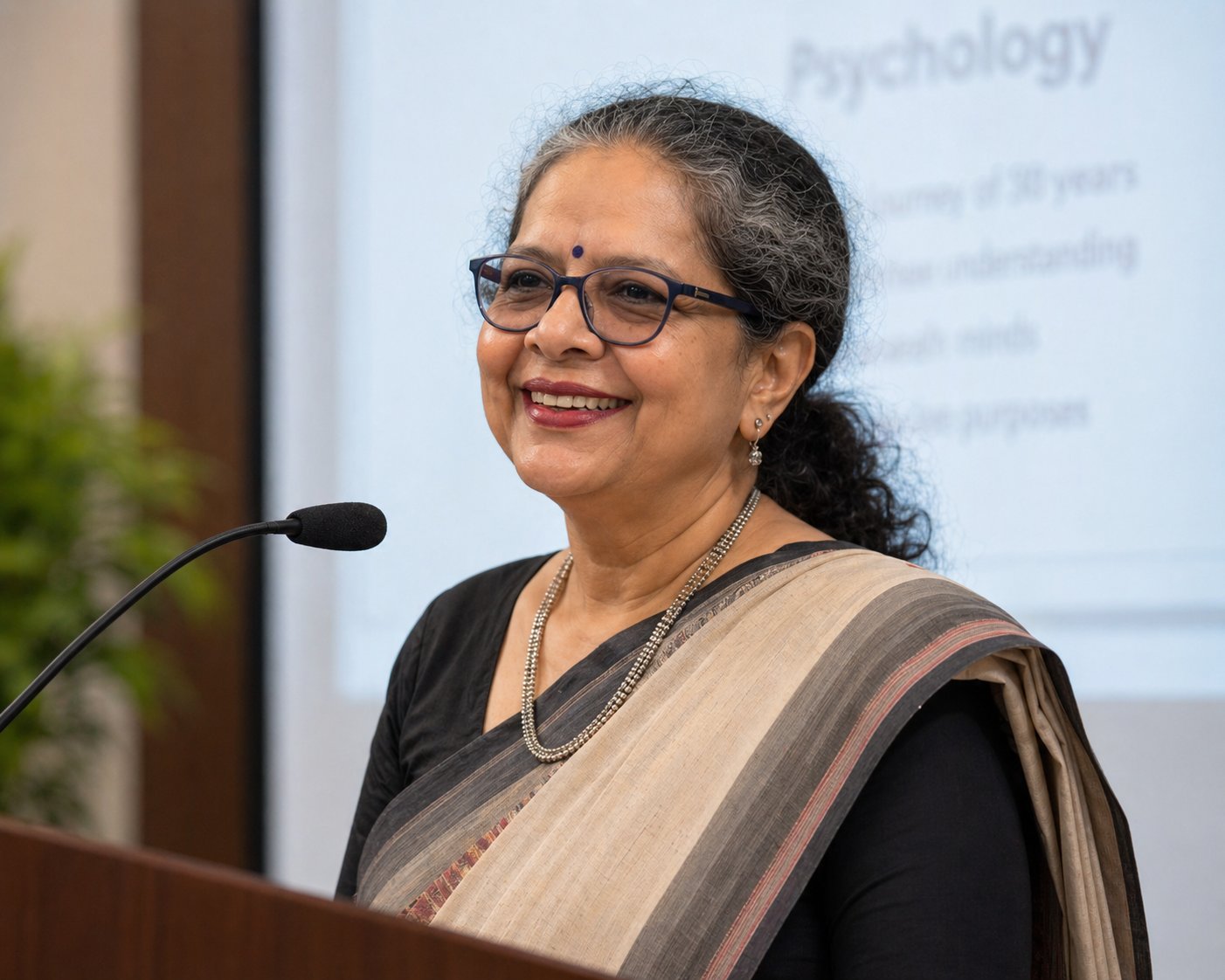
She has been practising in South Delhi since 1989. In that time she has trained in and integrated counselling psychology, CBT, clinical hypnotherapy, and past life regression — each modality adopted for the same reason: she saw it work, in ways she could not account for through what she already knew. Her PLR practice, the last addition, was the one she had the most reservations about. What changed her mind was a client whose chronic back pain and recurring nightmares — medically and therapeutically unexplained — resolved completely in two sessions. The metaphysical question remains genuinely open. The clinical outcome was not.
Her Mission
She describes her purpose simply: to help people cleanse what is within, so that they can live the full lives they came here to live. Not symptom management. Not coping strategies. Genuine healing at the source. This has been her aim since 1989, and the consistency of her clinical outcomes has given her no reason to lower it. She practises in South Delhi and online. Sessions are Rs.2,000 per 60 minutes for clients in India (US$40 per hour for international clients). English, Hindi, and Bengali. The contact buttons on this page reach her directly. Response within 24 hours.